
Note: I occasionally update this post with new information as I think of additional interesting data points to include, assuming I have the data!
Seven Months, 450 Applications: A Data-Driven Audit of a Tech Job Search
In September 2025, Supermassive Games made me redundant after two and a half years. I wrote about leaving then; this is about what I was looking for. In March 2026, I started as a Senior Systems & Applications Administrator at University of the Arts London.
Between those two dates sits seven months of job hunting. Because I label my email obsessively and LinkedIn hands over your data if you request it, I can tell you exactly what those seven months looked like. So I audited the lot: every labelled Gmail thread, every sent-mail chase, the LinkedIn data export, and the tracking spreadsheet I abandoned early on. This is what came out.
The Headline Numbers
At least 450 applications. I say “at least” because that only covers what left a traceable paper trail: 317 tracked through email, over 90 LinkedIn applications with no email footprint, a dozen speculative emails to studios, and 36 that survive only in the tracking spreadsheet I started on day two and abandoned within a month when volume defeated the tracking concept itself. Anything deleted, or submitted through a portal that never wrote back, goes uncounted. The true total is higher, and I have made peace with never knowing it.
| Stage | Count | Rate |
| Applications (floor) | ~450 | 100% |
| Explicit rejections | 175+ | ~39% |
| Silence (no response of any kind) | The rest | ~52% |
| Interview invitations | 33 | ~7% |
| Interviews actually held | 27 | ~6% |
| Rejected after interviewing | 17 | N/A |
| Offers | 1 | ~0.22% |
Seven months, 205 days from first application to offer, averaging 15 applications a week, with one peak week in late July topping 50. A meaningful chunk went out between 10 PM and 3 AM, including, fittingly, the formal application for the job I landed, submitted at four minutes past midnight. What can I say? I am a night owl.
The Shape of the Search
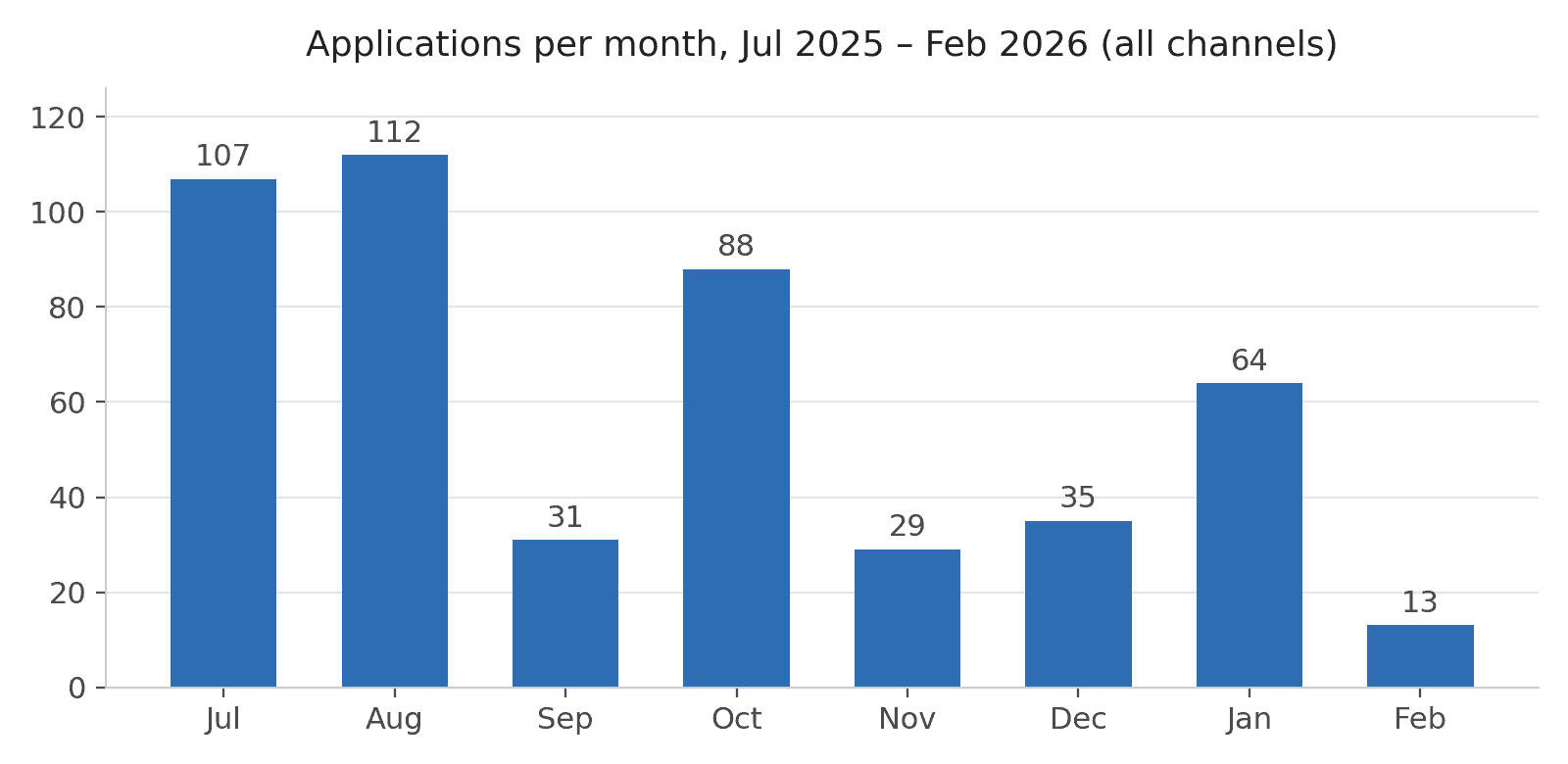
The search moved across four distinct phases:
- July–August Blast: I launched well over 200 applications while I was still working out my notice.
- September Lull: Spent actively interviewing.
- October Resurgence: Seeded the deepest processes of the search. Two companies took me to three interview stages each. Both processes then died quietly in the December trough, right when the entire hiring market hibernates.
- January Push: 64 applications and 9 concurrent interview processes running at once, one of which finished the job.
My CV version history maps the same terrain. Filenames confirm at least 30 revisions across seven months, 17 deployed on LinkedIn alone. The original lasted one week. Six revisions occurred during a frantic 10-day sprint in early September; one version held steady through the confident October push; and on the morning of the search’s two worst rejections, I revised it twice in a single day. New Year’s Eve produced two versions before midnight, the first week of January brought five more, and the 30th-odd revision, finished on 7 January, was the one in circulation when the application that ended the hunt went in two days later.
Thirty drafts, only to learn the document was never the problem.
What Was I Applying For?
Quick caveat: job titles survive only about half the applications (the LinkedIn export, the tracker, and active interview processes), so this is a sample, not a census. Even so, the sample contains the most useful practical finding in this entire dataset.
Applications by Role Type
(Across 229 applications where job titles survived. Conversion rates are indicative, not gospel.)
| Role Type | Applications | Interviews | Conversion |
| Support / Helpdesk / Desktop | 65 | 6 | ~9% |
| Other / Specialist | 38 | 3 | ~8% |
| Systems Admin / Engineer (Generalist) | 37 | 8 | ~22% |
| Infrastructure | 24 | 6 | ~25% |
| Cloud / DevOps / Platform / SRE | 22 | 5 | ~23% |
| Explicit Linux / Unix | 21 | 3 | ~14% |
| IT Management | 9 | 0 | 0% |
| Security | 8 | 1 | 13% |
| Explicit Windows / Microsoft | 5 | 1 | 20% |
Applications by Seniority Level
| Title Level | Applications | Share | Interviews | Conversion |
| Junior-marked (Junior / Associate) | 6 | 3% | 0 | 0% |
| Management-titled | 16 | 7% | 1 | 6% |
| Regular (Unmarked Mid-level) | 175 | 76% | 25 | 14% |
| Senior-marked (Senior / Lead) | 32 | 14% | 7 | ~22% |
Key Takeaways from the Role Data
- Applying down performs terribly: Support, helpdesk, and desktop roles made up nearly a third of everything I sent out. This was a senior sysadmin applying for service-desk work, assuming those jobs would be easy to land. They were not. They converted at half the rate of roles at my actual skill level. An overqualified applicant does not look like a safe pair of hands; he looks like someone who will leave the moment a better offer appears.
- Matching your level works: Generalist sysadmin, infrastructure, and cloud roles accounted for a third of my applications, yet produced two-thirds of my interviews. The market’s message was unambiguous: apply at your level. It took 450 data points to finally hear it.
- Pressure drives bad instincts: Down-level applying spiked to roughly half of my submissions in August and January, the two most stressful stretches of the search. Under pressure, the instinct is to apply below your level. The data proves it converts worse, not better. If you’re up at 2 AM ready to fire off a dozen helpdesk applications as insurance, send two at your actual level instead.
- Junior roles reject overqualification instantly: The six junior roles I applied for generated zero interviews. Not few: zero. Two rejected me outright, and the rest never replied. Meanwhile, senior-titled roles convert at 22%. The market does not hire insurance; it hires fit.
- The panic discount changes nothing: By day three, I was asking for less than I made previously. By day six, my floor had dropped roughly 20% below my former salary, and it stayed there. I offered a discount and volunteered the reason (“flexible due to redundancy”) on application forms. It converted nothing. One deskside role paid less than half my former salary; I told them in writing that it was acceptable and that I could start immediately. They rejected me within a week anyway. The job I ultimately accepted at UAL involved a modest 14% cut against Supermassive: a real, honestly named figure I can happily live with.
How Fast Do Rejections Arrive?
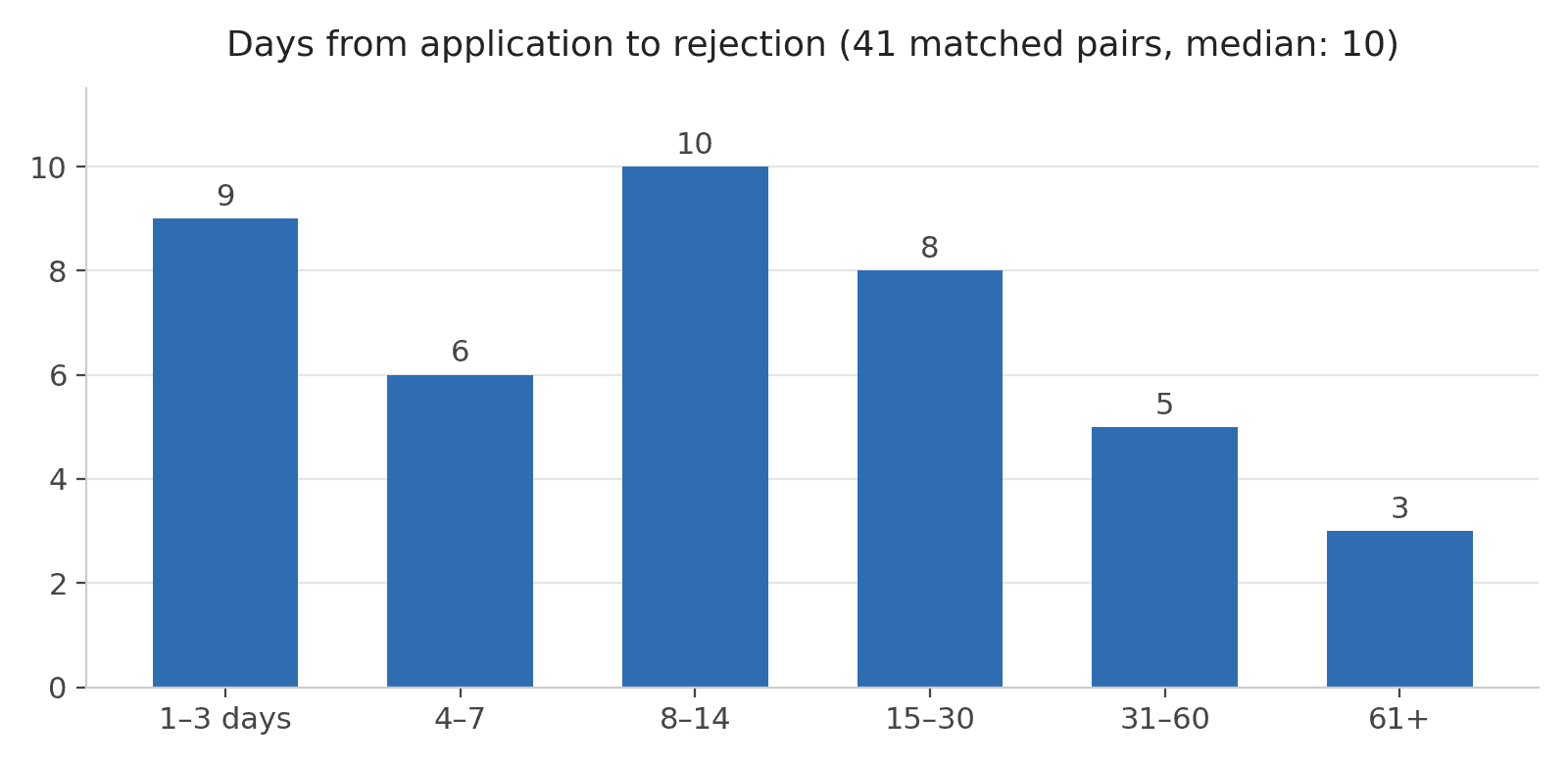
For 41 rejections I could pair directly with an application date, the median wait was 10 days.
- A quarter arrived within 3 days.
- A quarter took longer than a month.
- Fastest: Three companies tied for first place by rejecting me within 24 hours.
- Slowest confirmed: 78 days.
- Slowest unconfirmed: A phone interview in early September, followed by two chases, a “we’ll follow up,” and then permanent silence. The only email their agency ever sent me afterwards was a template rejection for a completely different vacancy, four months later.
The Chasing Experiment
Eight times during the search, I chased a company for a status update following a period of silence.
The surprising finding? Every company I chased replied within a day. However, responding isn’t the same as answering.
- 1 chase produced a rejection.
- 3 chases revived a genuinely live process.
- 1 chase yielded news that the role had been pulled (“business needs have changed”).
- 2 chases got a human holding reply, followed by permanent silence.
- 1 chase produced an autoresponder 48 seconds later, apologising for an absence that had ended the day before, followed by nothing ever again.
The most telling response was a rejection that arrived at 6:36 AM, 11 hours after my chase. Decisions like that are not made overnight; they sit in a drawer until someone asks. Which means a large chunk of my 200+ “no response” applications were actually decided long ago. Nobody ever pressed send.
What Actually Worked?
| Channel | Volume | Interviews | Offers |
| Direct Applications / ATS Portals | ~250 | ~15 | 0 |
| 113 | 4–5 | 0 | |
| Job Boards | ~65 | 2–3 | 0 |
| Speculative Emails to Studios | 14 | 0 | 0 |
| Recruiters & Agencies (Human Contact) | ~22 relationships | 7 | 1 |
Over 400 self-service applications yielded roughly 20 interviews and zero offers. Conversely, 22 relationships with real people produced 7 interview processes and the job.
ATS Platform Breakdown
(For 120 applications where confirmation emails survived)
| ATS Platform | Applications | Interviews | Notes |
| Greenhouse | ~21 | 0 | Polite automated rejection templates. |
| Workday | ~19 | 3 | DXC (x2), Darktrace. |
| Lever | ~14 | 1 | Numan. |
| Workable | ~14 | 2 | Proxymity, Kurt Geiger. |
| Ashby | ~13 | 0 | No interview movement. |
| Teamtailor | ~13 | 1 | M+C Saatchi. |
| SmartRecruiters | ~7 | 2 | Intelerad, NBCU. Best big-platform rate. |
| iCIMS / SuccessFactors / BambooHR | ~12 | 1 | JBi via BambooHR. |
| UK Public Sector Portals | ~5 | 3 | Included the final offer. |
Startup favourites (Greenhouse, Ashby, Lever) swallowed nearly 50 applications and returned a single interview. Unfashionable enterprise systems like Workday quietly produced three processes. Best of all were low-tech public-sector portals: five applications yielded three interviews and a job offer.
Sector match mattered immensely. I sent roughly 10 applications to universities, public bodies, and civic institutions. Five led to interviews (50% compared to 6% overall), and one became my job. Whatever my CV said, the public sector could digest it; the private sector mostly could not.
The Agency Lottery
Recruitment agencies were simultaneously my worst channel and my only successful one.
I submitted roughly 75 cold applications in response to agency ads on LinkedIn and job boards. Only 1 in 8 yielded a reply from a real human. However, once a recruiter engaged, 1 in 3 relationships led to an interview process, and only one led to an offer.
Agency Performance Binary:
[ Cold Agency Ad ] –> 1 in 8 got a human reply –> High ghosting rate
[ Human Recruiter ] –> 1 in 3 got an interview –> 100% of final offers
Tier 1: Produced a Live Process
- Hays: Handled UAL (three stages). Received an offer in 27 days; phoned through hours after the final interview.
- Think IT: Handled Homeprotect (three stages). Genuine phone-first advocacy throughout.
- Ashdown Group: T-Scan phone interview within two weeks. Then fell into permanent silence.
- Ocho People: Payroc interview booked before the process collapsed in mid-October.
- LinuxRecruit: Vorboss role pulled due to changing business needs. Fine conduct throughout.
- hackajob: BAE screening call. Withdrew when the role differed from the description.
- Responsiv’s agency: Arranged the first stage within a week. Withdrew due to commute length.
Tier 2: Human Contact, No Process
- Client Server: Phoned about a hedge-fund role a month post-application, then nothing.
- Primis: Confusing, delayed responses; time wasted.
- Brxio: Sent a polite, prompt rejection (a distinction in this tier).
- Intelstack & Delta Class Tech: Single email each, then ghosted.
- jackandjill.ai: Six messages of robotic courtship from an AI bot. Zero actual roles.
Tier 3: Total Silence (35+ Agencies, ~50 Applications)
Switch Tech Talent (5 applications), Miller Maxwell, Franklin Fitch, Hamilton Barnes, Stanford Black, Premier Group, Klyk, Fortray, Hunter Bond, Signify, Oliver Bernard, and dozens more never acknowledged any submissions.
The practical rule: if an agency hasn’t responded within a fortnight, they won’t.
Breakdown of Written Rejections
Out of ~160 written rejections, here is what companies actually said:
- “High Volume / Many Applicants” (30 rejections, ~20%): The workload defence, sometimes sent within 72 hours of applying.
- “Skills Better Aligned Elsewhere” (21 rejections, ~13%): A reason-shaped non-reason.
- “Careful Consideration Given” (Pervasive): The universal template opener.
- The word “Overqualified” (0 occurrences): The actual operative reason, never explicitly stated.
- Specific, Actionable Feedback (~5 instances, ~3%): Exclusively from humans who knew my name.
Feedback is not something hiring processes produce; it is something relationships produce.
Sender Classification
- Declared No-Reply Addresses: ~90–95 (Over 50%)
- Machinery in Disguise (MyWorkday, SuccessFactors, iCIMS tokens): 31 (~20%)
- Incorrect / Bounced Address: 1 (DXC)
- Mailbox with a Detectable Human: ~30–40 (~25%)
I replied to 18 rejections that came from human-looking addresses. Six replied, and one reversed the rejection.
Speculative Approaches & “White Whales”
Cold Studio Emails
Shortly after the redundancy, I emailed 13 local game studios and post-production houses directly (no ATS, just a CV and a human note). Five replied, and three were warm and personal. Zero produced jobs because local studios knew the market conditions and lacked headroom. Still, those human replies were the kindest correspondence of the entire seven months.
The Visual Effects (VFX) Loop
For nearly a decade, I have tried to break back into VFX after spending 6 years in the field early in my career. My mailbox archive shows that the door was stubborn even when I was securely employed:
- Framestore: I applied in 2018 and 2019, and I had a video interview in 2022, followed by silence. In August 2025, after the redundancy, I applied for a lower-level Data Services Technician role, and got total silence.
- Territory Studio: Interviewed in 2021, turned down kindly. Applied for a junior role on Christmas Eve 2025, rejected via template in the New Year.
- Industrial Light & Magic (ILM): Applications spanning 2018, 2022, 2024, and late 2025 (ranging from Senior Sysadmin down to Systems Admin I). I submitted every application through Disney’s Workday portal, and it was silently marked as rejected without an email notification.
Trying to re-enter VFX by applying further beneath my skill level proved more stressful than working in the industry ever was. I still enjoy watching the film credits; I have stopped checking the portal.
Credit Where Due: The Good, the Bad, and the Ugly
The Good
- Hays: Called at every step, provided prep support, checked in before interviews, and called with an offer within hours of the final stage.
- Epic Games: Sent an unprompted status update purely to explain where things stood.
- Octopus Energy: Rejected me twice, both times with genuine, thoughtful feedback from a real human.
- BBC: Conducted a proper panel interview and delivered actionable feedback within two weeks.
- London Library: Gave an off-profile application a fair interview and communicated with humanity throughout.
The Bad and the Ugly
- M+C Saatchi: Screened me, went silent for 17 days, then sent a rejection at 6:36 AM (11 hours after my chase). Repeated the exact behaviour nine weeks later.
- Techex: Promised an update, vanished, and generated an autoresponder 48 seconds after my chase before disappearing permanently.
- Perforce: Lost my email responses (despite mail logs proving delivery), booked an interview, let it die over Christmas without rebooking, and then cancelled the role.
- Supermassive Games: Four months after making me redundant, I applied for an open Security Engineer role. They rejected me with personal notes from people who knew my work. While handled politely (on their end), receiving a “no” from the people who know your capabilities best was easily the most painful moment of the search.
How It Ended
I applied for my current role at University of the Arts London in early January 2026 through Hays. The entire process, from the initial phone call to the formal offer, took 27 days: a prep call, a first interview, an in-person second interview, and a verbal offer phoned through two hours later.
After seven months of ghosting, 10-day medians, and automated rejections, the organisation that actually wanted me moved with absolute clarity. That is the ultimate takeaway for anyone still navigating the search: the right employer does not leave you guessing.
I started at UAL on 9 March 2026.
Methodology & Caveats
- I compiled data from labelled Gmail threads, sent-mail logs, a LinkedIn export, and early tracking sheets, with Claude helping parse raw text.
- Figures represent floors: deleted emails are not counted, phone-only updates leave no paper trail, and portals like Workday don’t issue emails for status changes.
- Nearly every audit correction moved an “unknown” into the rejection column. Draw your own conclusions about the remaining unknowns.